TRAVEL ARTICLE
Polar Night
ARTICLE BY OLLIE TAYLOR ON 27 May 2026

ARTICLE INDEX
Polar Night
Polar night is the period in winter when the sun does not rise above the horizon for at least 24 hours. It occurs in regions north of the Arctic Circle and south of the Antarctic Circle, where the geometry of the Earth itself begins to override the familiar rhythm of day and night.
The cause lies in the Earth’s axial tilt—around 23.5 degrees. As the planet orbits the sun, this tilt means that during winter in the Northern Hemisphere, the Arctic is angled away from the sun. For locations above roughly 66.5° north, there comes a point when the sun’s daily path arcs entirely below the horizon. It is still there, still tracing its course across the sky, but it never climbs high enough to be seen.
How far below the horizon the sun sits depends on latitude. Just north of the Arctic Circle, it dips only slightly beneath it, allowing a lingering twilight to fill the day. Further north, the sun sinks deeper, and that twilight fades—from soft civil light to the dim wash of nautical twilight, and eventually toward near-total darkness.
Polar night, then, is not simply the absence of sunlight. It is the result of a precise alignment between Earth’s tilt, its orbit, and your position on its surface—a seasonal shadow cast not by clouds or weather, but by the planet itself.

At a Glance
Phenomenon
Polar night: when the sun remains below the horizon for 24 hours or more
Why It Occurs
The Earth’s axial tilt (23.5°) angles the Arctic away from the sun in winter, keeping its daily path entirely below the horizon at higher latitudes
Threshold
North of the Arctic Circle (66.5°N)
West Greenland Latitudes
Nuuk — 64.1743° N
Ilulissat — 69.2198° N
Uummannaq — 70.6767° N
Upernavik — 72.7863° N
Pituffik — 76.5293° N
Latitude
Latitude determines how far the sun falls below the horizon—and how much light survives.

Polar Night in Greenland
In Greenland, winter does not arrive with a clean edge. It deepens. The light thins, the sun lowers, and then—quietly—it disappears. What replaces it is not uniform darkness, but something more nuanced: a slow unravelling of daylight, stretched along the country’s west coast and measured in degrees of latitude.
Here, polar night is not a single condition. It is a continuum, shifting from place to place, town to town, each settlement holding on to a different fraction of the sun’s absence.
However, in the very far northwest of Greenland, some towns reside in near darkness for almost two months during the winter.
A Coastline That Darkens by Degree
Nuuk – 64.1743° N
The sun does not disappear at any time during the year
In Nuuk, the capital, the sun refuses to vanish completely. Even at the winter solstice, it rises—briefly, low, and oblique—skimming the horizon before slipping away again. The day is compressed, but recognisable. Light still casts shadows. Time still divides itself into day and night.
Here, winter daylight light lingers, almost at the threshold latitude of polar nights.

Ilulissat – 69.2198° N
A day without a sunrise
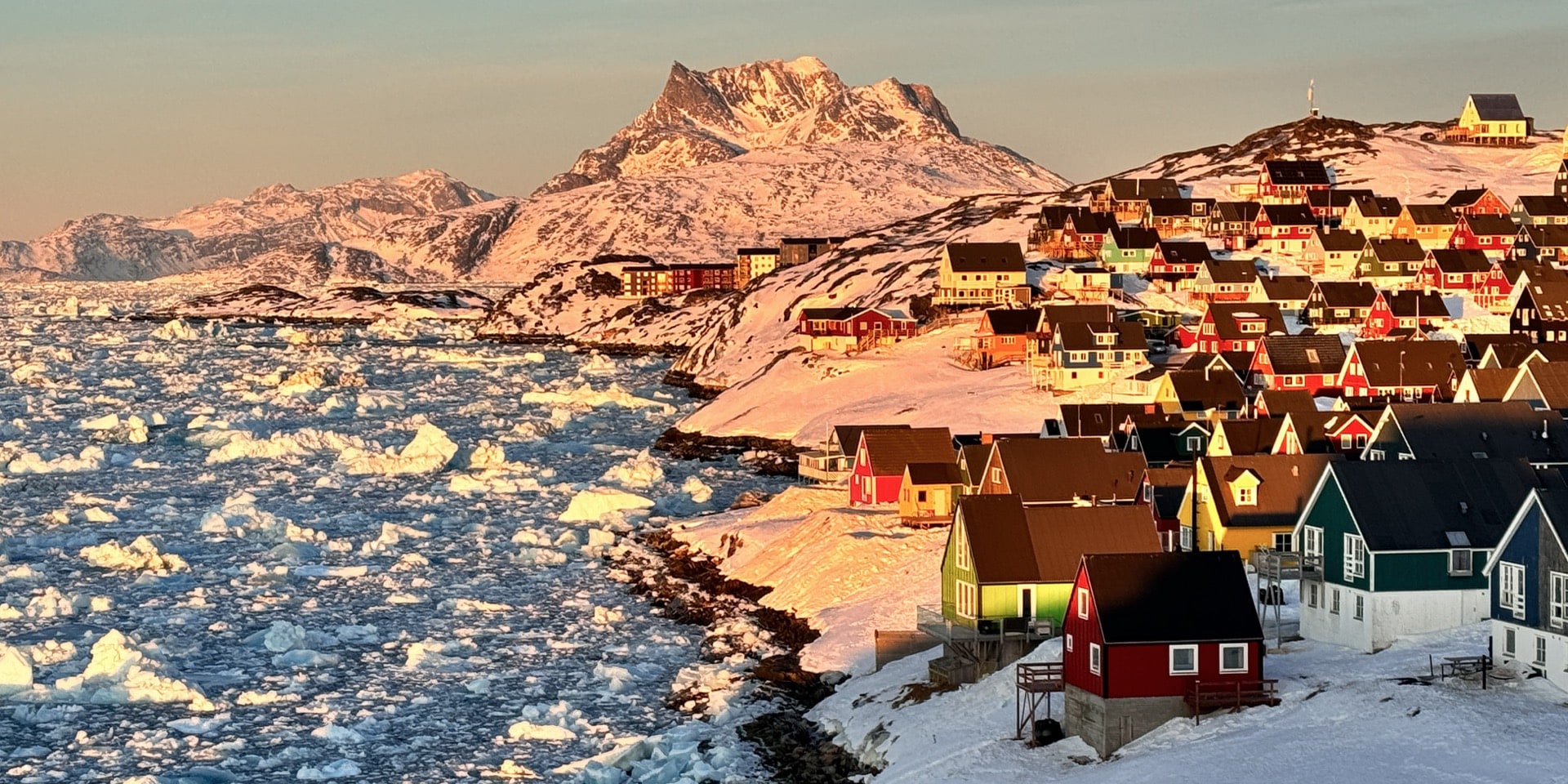
Further north, in Ilulissat, the sun no longer rises. Around 21st December, it remains below the horizon entirely. And yet, the day does not vanish, instead, it lingers as twilight that is as bright as daylight just before sunrise on a clear day for a few hours.
As the almost false daylight fades, the day lingers, the southern sky glows in muted bands, reflecting off ice and snow, creating the illusion of a day that never fully forms.
Uummannaq 70.6767° N
Light reduced, but not lost
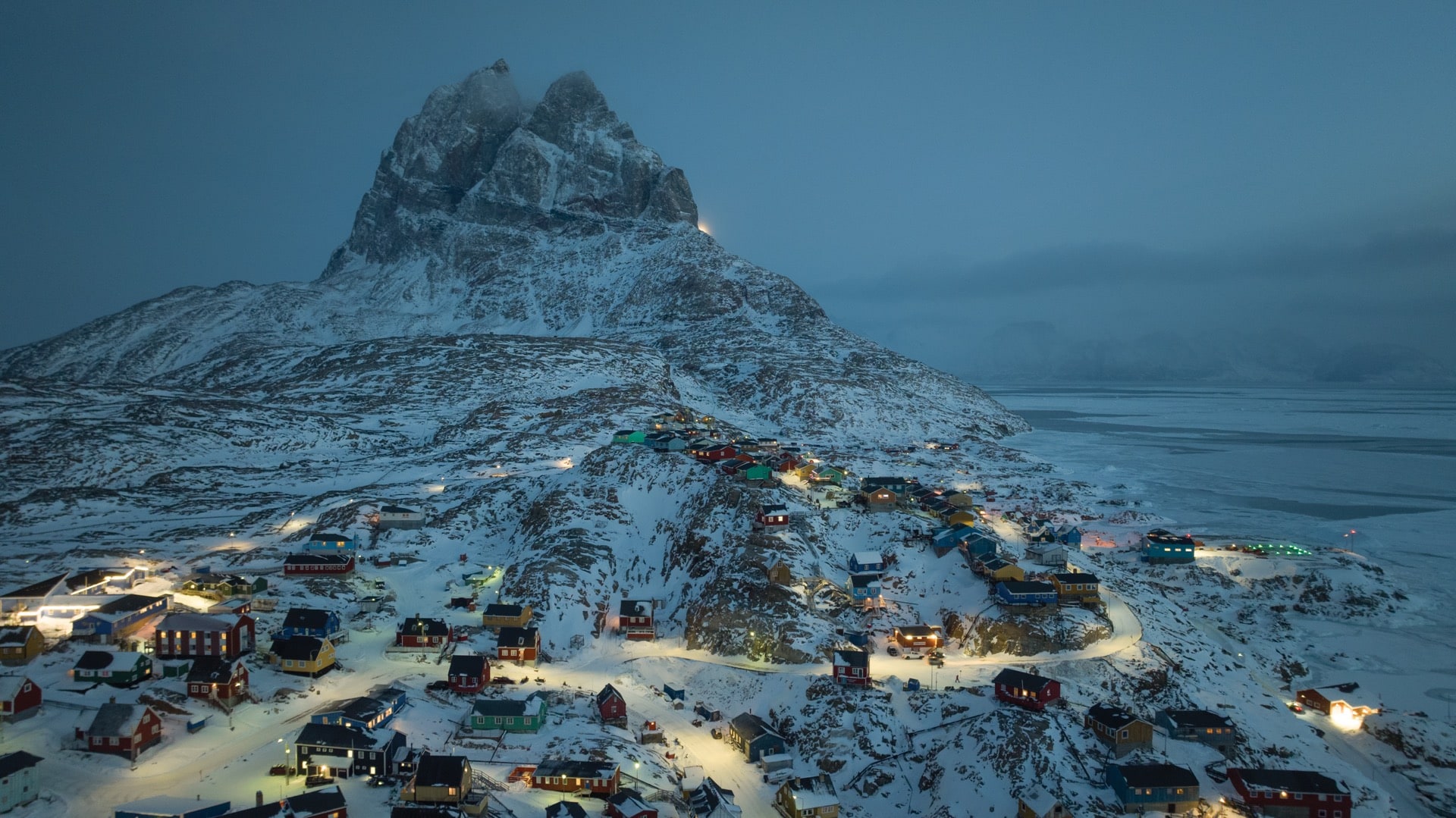
In Uummannaq, the margin tightens. The sun sits further below the horizon now, its influence weakened. The glow shortens, dims, and clings low to the southern horizon for much of the day.
The day becomes more fragile here, though even at the winter solstice (21st December), the region still receives around three hours of civil twilight—the brightest phase of dawn and dusk, when the landscape remains visible despite the sun’s absence. Either side of this, Uummannaq slips into extended periods of nautical twilight, where stars emerge and the Northern Lights often take hold. On clear days, a soft pre-dawn and post-dusk glow lingers along the southern horizon, hinting at a sun that never rises.
Under overcast skies, that distinction fades. Civil twilight dulls into a muted wash behind cloud, and the remaining light thins to the point where day and night become almost indistinguishable an atmosphere that feels less like winter daylight, and more like a continuous, suspended night.
Upernavik 72.7863° N
Where the day begins to disappear
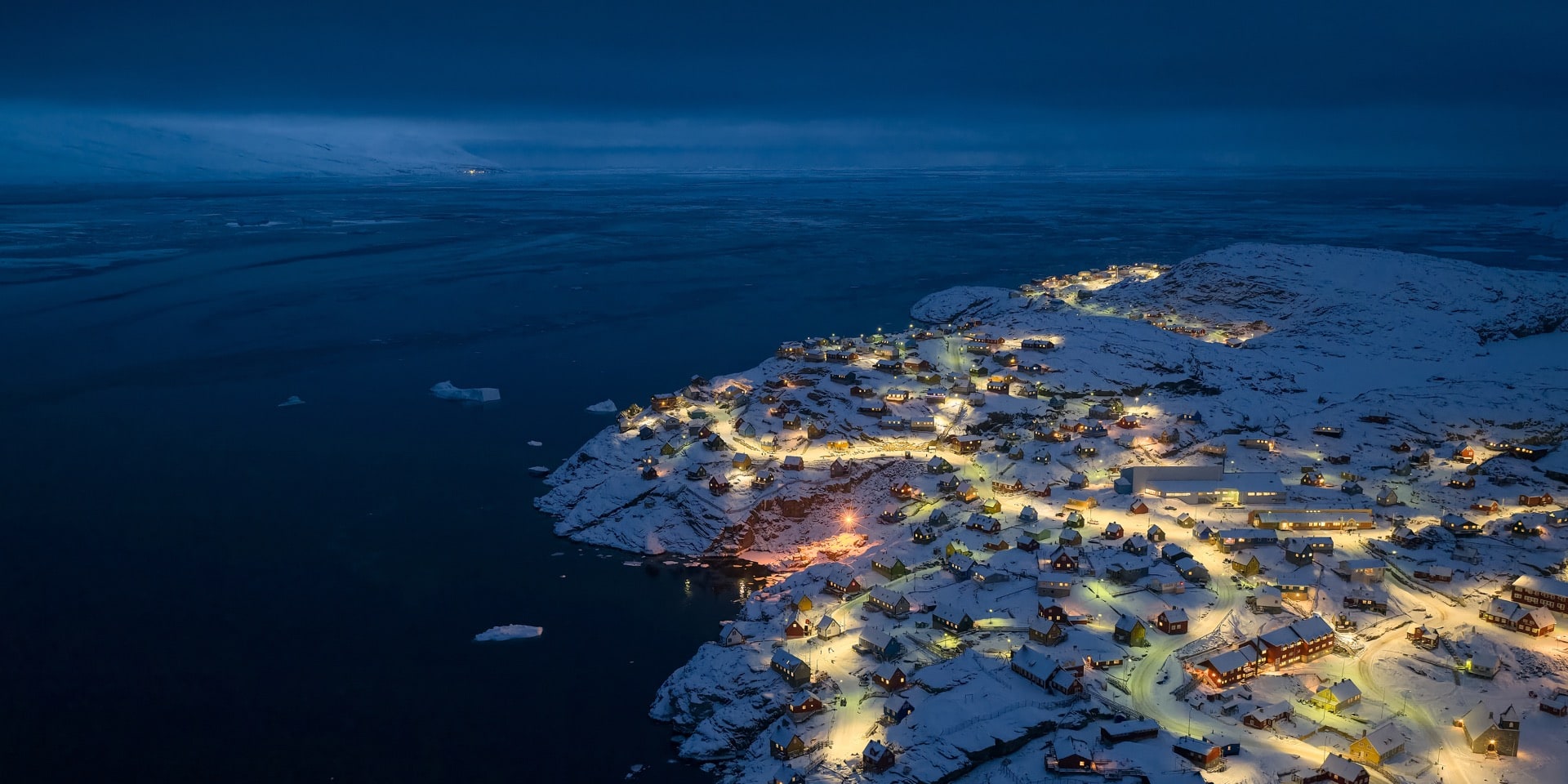
By the time you reach Upernavik, the Arctic has fully asserted itself. The sun lies far enough below the horizon that even midday brings only a faint lift in brightness.
The landscape flattens into shadow, and the boundary between day and night begins to blur. For a few hours at the height of the day, there is just enough light to suggest the possibility of sunrise—but it never comes. Sitting on the cusp of the civil twilight threshold, this is a place where daylight feels close yet remains out of reach.
Under overcast skies or snowfall, even that subtle distinction fades. The world darkens further, though never completely held instead in a dim, atmospheric glow that lingers just above true night.
Pituffik 76.5293° N
At the edge of true polar night
At Pituffik, in the far northwest, the system reaches its limit. Around the solstice, the sun sits so far below the horizon that even twilight becomes brief and subdued, appearing only as a short, dim window on clear days.
What remains is an Arctic day reduced to its bare minimum—a narrow band of muted light surrounded by long stretches of darkness. At this latitude, the region lies beyond the reach of civil twilight, existing instead within the nautical twilight zone. The faint glow on the southern horizon, visible at what should be midday, is not direct light but a distant spill from lower latitudes where the sun still exerts influence.
Under overcast skies or snowfall, even this subtle distinction disappears, and the landscape settles into near-continuous darkness. Polar night here is not just prolonged—it is deep.
Venture further north still, and even nautical twilight fades. These higher latitudes enter the realm of astronomical twilight, where the sun lies so far below the horizon that no meaningful daylight remains. For long periods of the polar winter, darkness becomes complete, broken only by starlight, moonlight, and the occasional arc of aurora.

The Long Arctic Night – Understanding Polar Twilight
At the winter solstice, around 21st December, the Northern Hemisphere is tilted furthest away from the sun. Because the Earth sits on a 23.5° axis, the sun’s daily path drops entirely below the horizon at higher latitudes, creating polar night.
What defines these differences is not simply whether the sun rises, but how far below the horizon it sits. That depth determines the type of twilight, and the kind of light that remains.

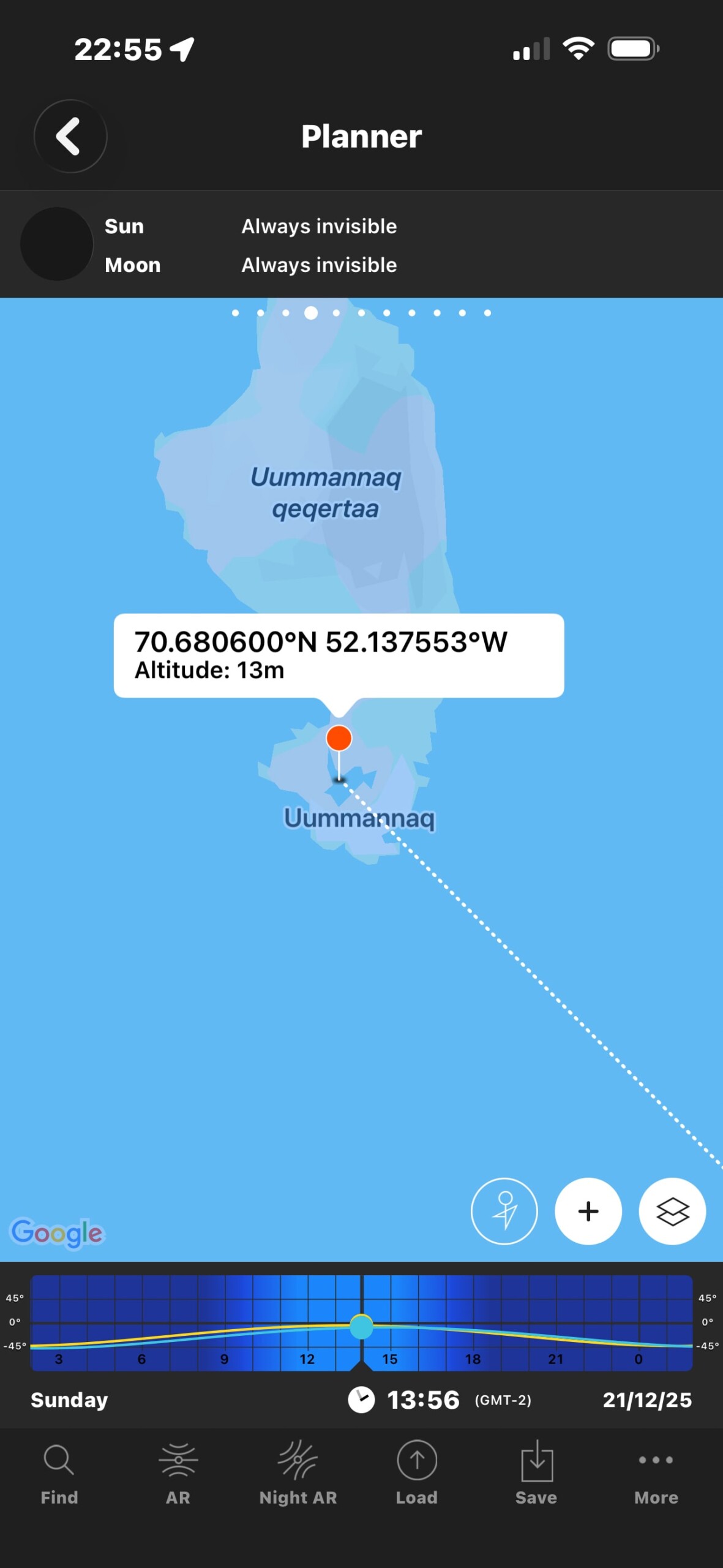
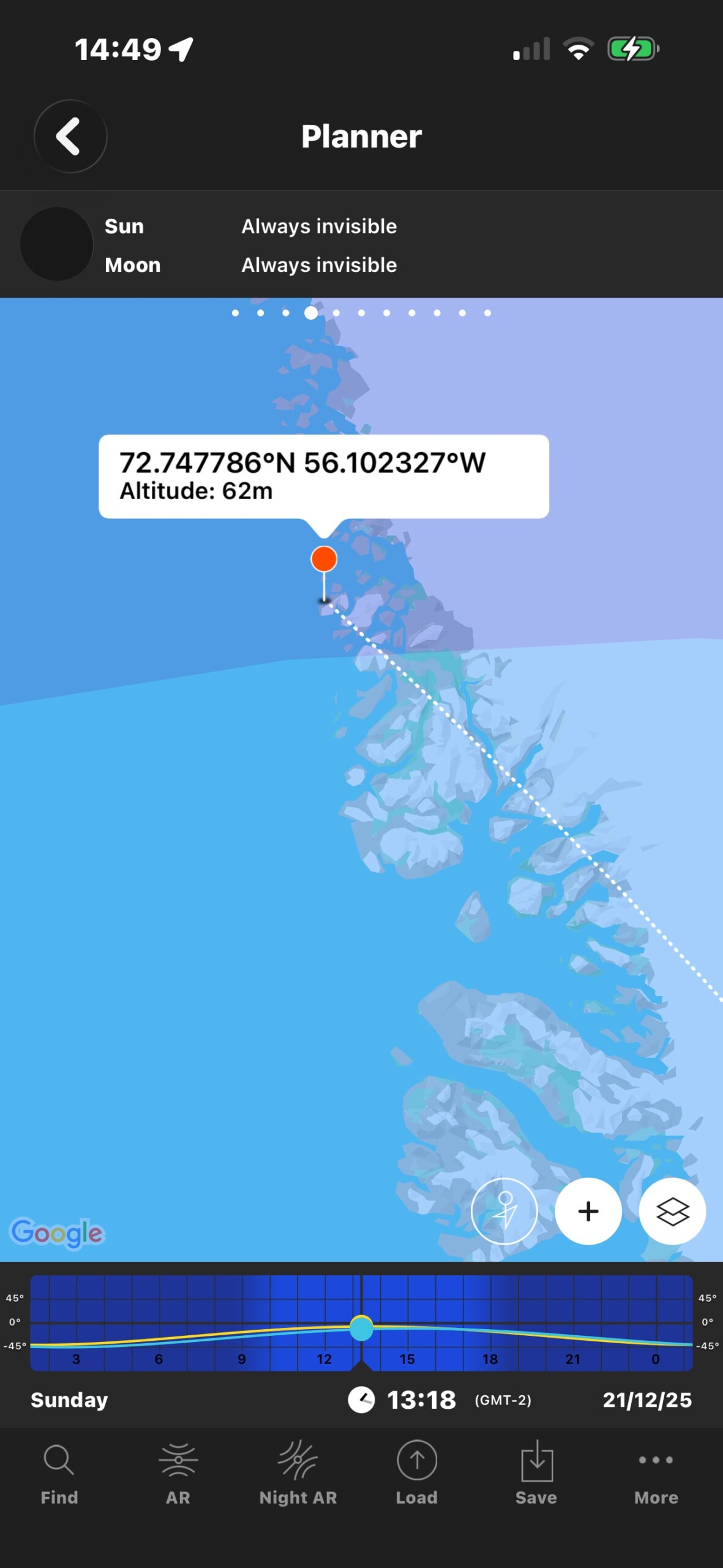
Using apps such as PhotoPills, we can see the duration of the sun above the horizon at different latitudes (shown in the top bar above the map)

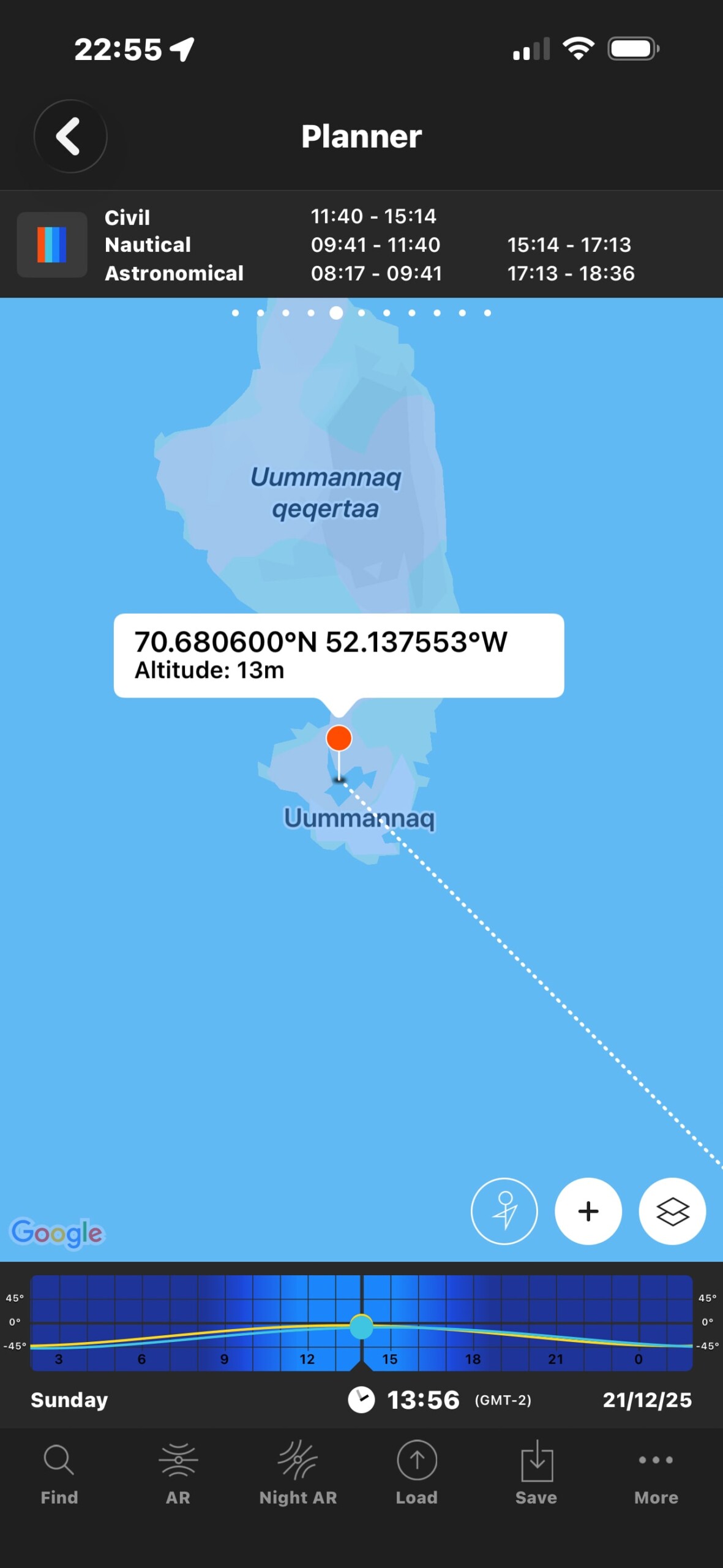
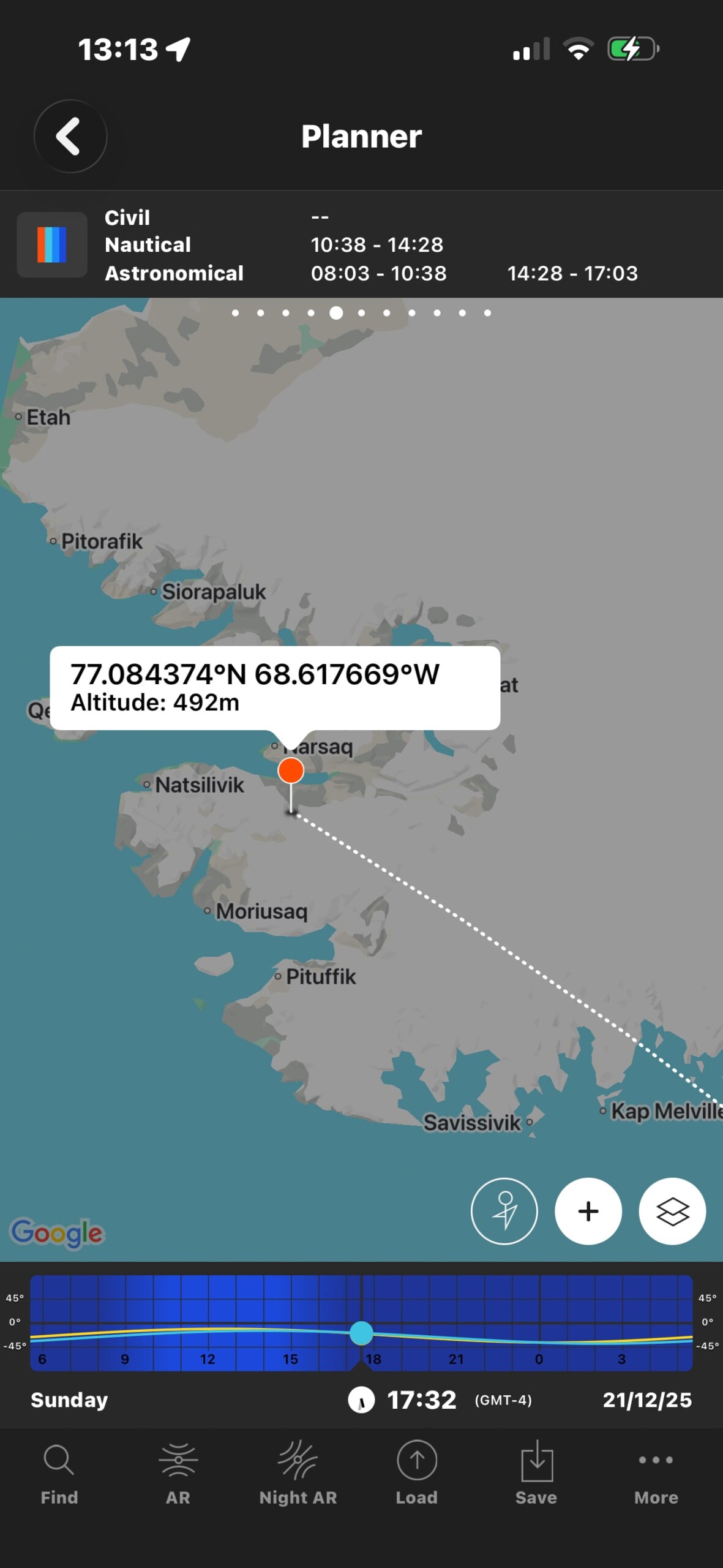
We can also use PhotPills to see the duration of the different twilights at different locations and latitudes (shown in the top bar above the map)
Civil Twilight
Sun: 0° to 6° below the horizon
This is the brightest phase of polar night—and the most deceptive.
The landscape remains clearly visible. Snow and ice hold detail, colour lingers, and under the right conditions it can feel remarkably close to daylight. In places like Ilulissat and Uummannaq, this forms the core of the “day.”
It is entirely possible to stand in civil twilight and feel as though the sun has simply chosen not to appear.

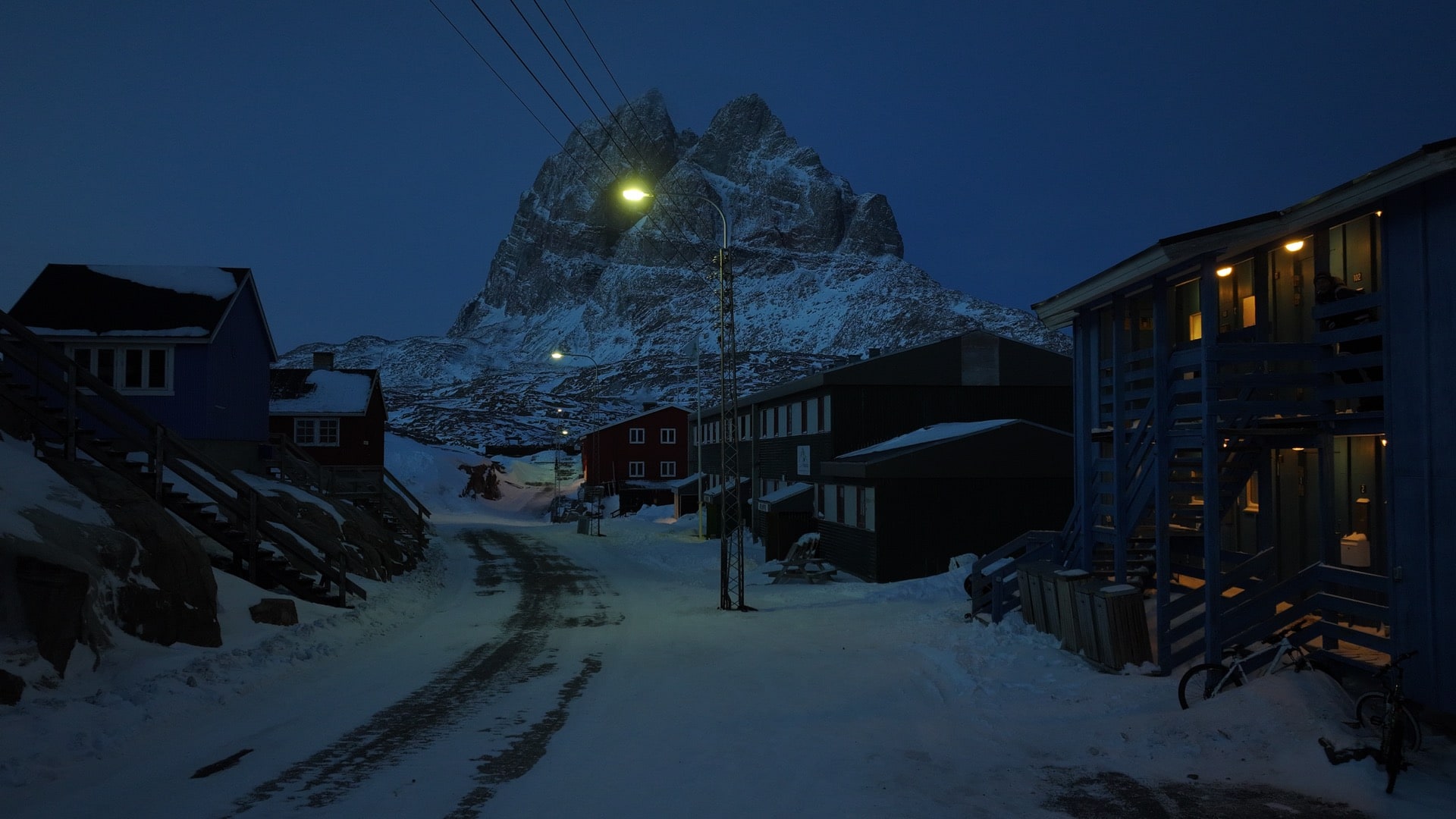
Nautical Twilight
Sun: 6° to 12° below the horizon
As the sun drops further, the world begins to lose structure, instead bathed in a deep blue our below the brightest stars and constellations.
The horizon softens. Detail fades. Settlements begin to rely on artificial light. Yet the sky becomes more expressive stars emerge, while the southern horizon carries a faint, rising glow, like the earliest stage of sunrise held in suspension.
This is the dominant condition further north, where daylight exists more as suggestion than substance.

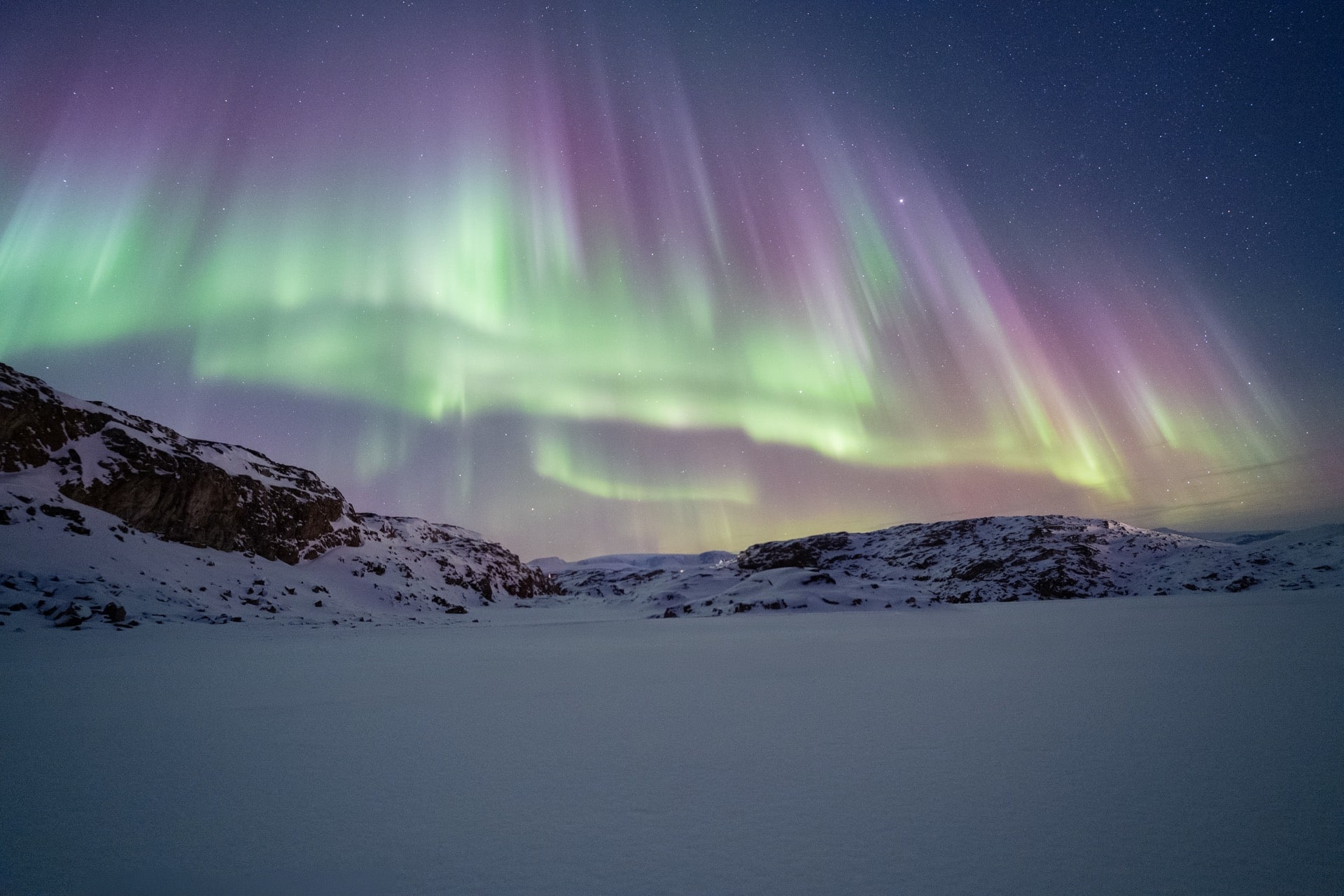
Astronomical Twilight
Sun: 12° to 18° below the horizon
This is the threshold of true night.
To the eye, the landscape appears dark. The sky fills with stars, and the Milky Way strengthens. And yet, even here, the Arctic rarely becomes completely black.
Low on the southern horizon, there is often a faint residual glow—light scattered from lower latitudes, leaking into the sky. Cameras reveal it more clearly than the eye: a subtle gradient that marks where the sun would be, far below, cameras still render a blue hue to nightscape shot in astronomical twilight, even though it looks dark to the eye.
Arctic Night
Progression by latitude and location:
Nuuk → true daylight
Ilulissat → extended civil twilight
Uummannaq → reduced civil twilight
Upernavik → nautical twilight dominates
Pituffik → brief twilight, prolonged darkness
What changes is not just the presence of light, but its quality, from functional daylight to prolonged dusk, to something approaching night.
Altitude: The Quiet Adjustment
Latitude defines the structure of polar night.
Altitude refines it.
Climb above sea level and the horizon expands. That expansion allows you to catch the first and last traces of twilight, subtle, but noticeable. In higher terrain, the glow can linger just a little longer, reaching places that remain in shadow below.
Altitude does not change the rules.
But it gently shifts your perspective within them.
Polar night is often imagined as darkness, though it is something more precise.
It is the measurable absence of the sun, and the persistence of its light fading, layer by layer as you move further north.
Travel the up the Greenlandic coast in the midst of winter, and you are not simply entering the night. You are watching it take hold, one degree of latitude at a time.